BAHIYA: A Full Brand and UGC Content Pack, Built in 48 Hours with AI
A fictional clean beauty brand built to time a real question. Zero to a full identity and a paid social ready presenter film, in 48 hours.
The brief
BAHIYA is a fictional Tunisian clean beauty brand built to answer one real question: how long does it take to go from zero brand assets to a paid-social-ready AI UGC video and full brand identity, using AI production with human creative direction?
The answer, documented here: 48 hours.

The hero product is the Bahiya Glow Serum, a lightweight face oil built on prickly pear seed oil cold-pressed in Kasserine, Tunisia, and jasmine extract from Nabeul on the coast. Two real ingredients, two real places. The brand’s fictional problem: a CTR of 1.2% on paid social, against a beauty industry benchmark of 3 to 4 percent. The diagnosis: no UGC. No real-person recommendation video. Static product creatives are not enough in a category driven by trust.
What was produced
Everything below was created from scratch within the 48-hour window:
Brand logo system: primary lockup with botanical arch icon and bilingual Arabic and English wordmark, secondary wordmark, and B monogram. All in deep forest green.
Color palette locked from the logo generation output.
30ml amber glass dropper bottle with branded label, lifestyle flat lay with Kasserine prickly pear and Nabeul jasmine botanicals
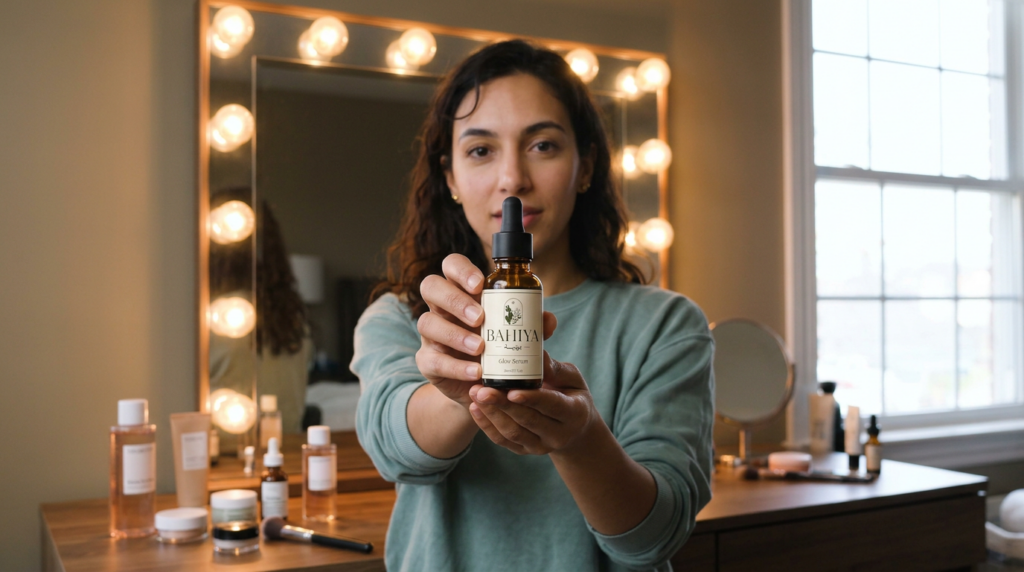
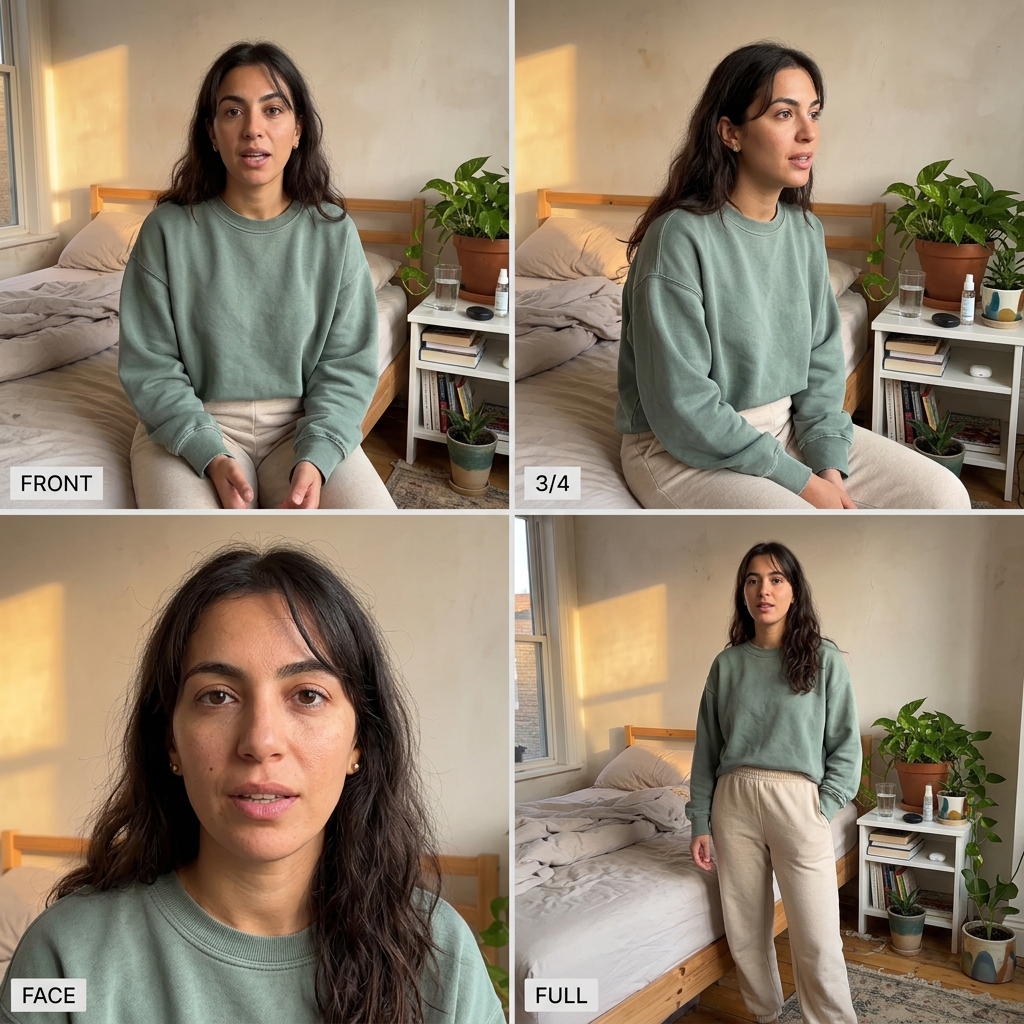
AI avatar persona: a Tunisian-British woman, late 20s, beauty-literate, at a Hollywood vanity mirror setup with morning light and warm tungsten practicals behind her, skincare products on the table surface. Dressed in a sage crewneck sweatshirt and oatmeal joggers. Not a studio, not a seamless backdrop.
UGC video: avatar clips generated from AI keyframe stills and animated with an AI motion model, B-roll from AI text-to-video generation, assembled in Premiere Pro with AI voice normalization for consistency across clips.
The production process
Brand identity came first. I wrote a creative direction brief covering the brand story, the ingredient provenance, the target buyer, and five personality pairs: what BAHIYA is and what it is not. That brief went to an AI image generation model with full creative freedom. The model proposed a high-contrast Didone serif wordmark, a botanical arch icon combining prickly pear and jasmine, and chose deep forest green unprompted. That color became the entire palette anchor.
The product bottle was generated in two passes: an unbranded amber glass dropper first, then a second pass with the approved logo fed as a reference image, producing a labeled bottle that matches the brand system exactly.
The avatar persona required the most craft. The character brief was specific: North African and Mediterranean features, warm olive skin with visible texture, unwashed-day hair, sage crewneck sweatshirt and oatmeal joggers. The setting: a Hollywood vanity mirror with warm tungsten bulb practicals running around the mirror frame, morning daylight from a window to the right providing a cooler secondary fill. The framing was intentional: this should look like frame grabs from a phone recording, not a fashion editorial. AI image models default toward the editorial register without explicit direction against it.
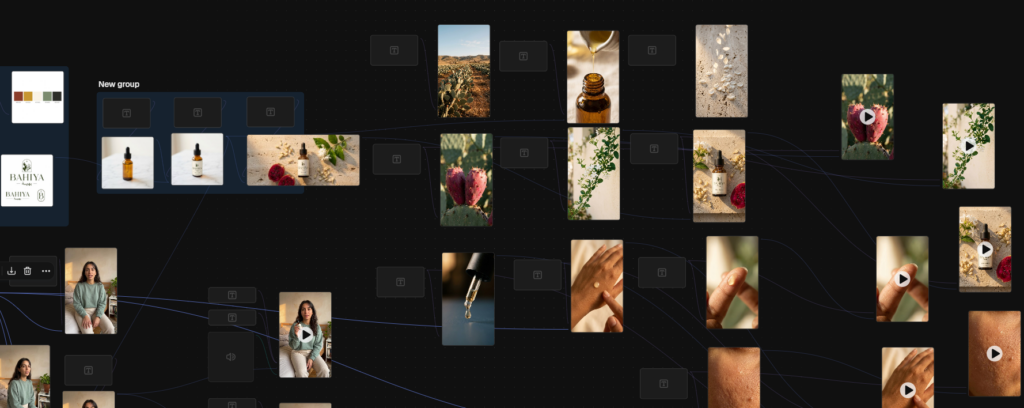
Video production followed a keyframe animation pipeline. For each beat of the script, I generated a posed still using an AI image editing model, with the approved avatar image as the base reference. An AI motion model then animated between pairs of stills (a start frame and an end frame per clip), interpolating the motion arc between known positions. This approach produces genuine upper-body movement: lean-ins, hand gestures, natural head turns. Each clip was generated with its own audio, assembled in Premiere Pro, and run through an AI voice normalizer to produce a single consistent voice timbre across all clips. B-roll clips generated separately via AI text-to-video covered the ingredient origin beats and product application close-ups.
The scripts were written to the avatar’s persona: beauty-literate, speaking as a peer. Every script names Kasserine and Nabeul specifically. No vague wellness language. The linoleic acid percentage (78%) is cited because precision is what earns trust from a buyer who reads ingredient labels.
Production challenges worth knowing about
Three engineering problems came up during production that are representative of working at the edge of current AI video tools.
Dual-prop complexity in still generation.
The original plan had the avatar holding the dropper bottle in one hand while showing a single drop of oil on the extended index finger of the other. The AI image editing model cannot reliably manage two complex prop interactions simultaneously. One element consistently degrades. The solution: simplify to one complex element per frame. The bottle goes on the table, already used. The fingertip holds the drop. The viewer reads the sequence correctly without both props in frame at once.
Close-up framing in AI image editing.
Describing a forward lean in physical terms (“leaned 60 degrees forward”) makes the model rotate the body but leaves the apparent camera distance unchanged. The face ends up the same size in frame, just hunched. The fix is to describe the target composition instead: “reframe as a beauty close-up, face fills 60 percent of the frame height, torso visible only from the collarbone up.” Image editing models respond to composition targets, not physics simulations.
Voice consistency across animated clips.
Each AI-generated clip produces a slightly different voice: different timbre, energy level, accent drift. Trying to fix this clip by clip is not viable. The correct workflow: generate every clip with its own audio, cut the edit to that audio in Premiere, export the full VO track, run it once through an AI voice normalizer, and replace. The normalizer produces a single consistent voice in one pass without disturbing the edit timing.
The seven advantages AI production brought to this project
Speed
48 hours from brief to full content pack. Sourcing a creator, agreeing terms, scheduling, shooting, editing, and revision rounds runs 3 to 4 weeks at minimum. The traditional equivalent takes more than six times as long.
Zero location cost
The Kasserine and Nabeul provenance story is told fully without travel. The ingredients are named and grounded. The lifestyle imagery evokes Tunisia without requiring a production trip.
Zero creator fee
No exclusivity clause. No rate negotiation. No off-brand post to manage the week after the campaign runs.
Unlimited versioning
The Tunisian darija version of this content pack is the same avatar, re-voiced. No reshoot. No rebriefing a creator in a second language.
Consistency across cuts
Every cut (the 90s hero, the 60s TikTok, the 45s Reel, the 30s feed ad) is the same face, same setting, same brand energy. A creator produces one shoot. AI production produces a library.
Platform-native engineering
Each script was written for its format from the start: TikTok skips the problem beat, the IG Reel leads with the ingredient fact, the 30s cut is structured for paid placement with a direct CTA. Not one long video edited down, but four separate intent structures.
Paid-ready from day one
The content was structured for amplification before it was produced. Platform specs, caption structures, and disclosure framing are part of the deliverable, not an afterthought.
The result
A finished UGC video, assembled from AI-generated avatar clips, AI-generated B-roll, and a voice-normalized audio track, edited in Premiere Pro and ready for paid social placement. Within the fictional scenario: paid social CTR lifts from 1.2% to 3.8% within two weeks. Zero influencer fees. Zero studio costs. The avatar passes a quality review: no AI tells, no uncanny valley. The content runs on paid day one without additional asset preparation.
The real outcome this demonstrates: a brand with no video content presence, no creator relationships, and no production budget can enter a content-driven category with a credible UGC pack. What took weeks and thousands in fees now takes two days and a considered brief. The gap between having the product and having the content to sell it has closed.
What this project proves
AI production does not replace creative direction. It removes the logistical and financial barriers that used to make certain types of production inaccessible to early-stage brands. The brief still needs to be right. The persona still needs to be specific. The ingredient story still needs to be real. The platform structures still need to be understood. The engineering problems still need to be solved. What changes is who can afford to execute.
Disclosure
BAHIYA is fictional. The production method is not.